
Scorpion Control in San Antonio, TX
Honest about what works, what doesn't, and why scorpions are harder than most pests.
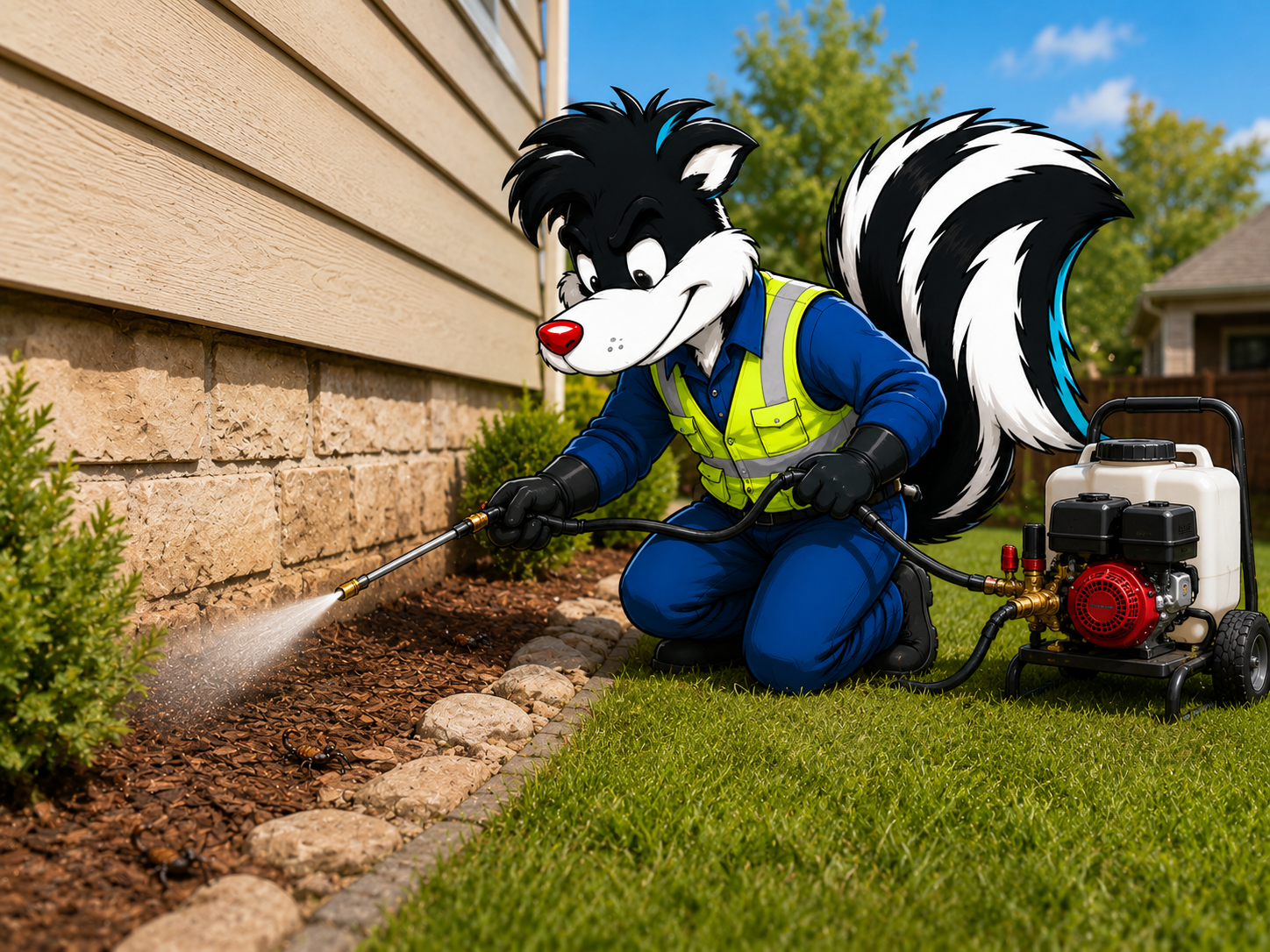
Scorpions are the pest people find most unsettling and the one most likely to leave them disappointed by a treatment. That is worth saying up front. They are genuinely difficult to control — harder than roaches, harder than ants — and any company promising to eliminate them from your property is telling you what you want to hear. What can be done is reduce them substantially, and that depends far more on how the treatment is applied than on what is applied.
What You Have Is Almost Certainly a Bark Scorpion
The striped bark scorpion is the common scorpion across San Antonio and the Hill Country. Tan to yellowish, usually two to three inches including the tail, with two darker stripes running down the back.
Two things separate it from what most people picture:
They climb. This is the part that surprises everyone. Bark scorpions can climb walls, cabinets, and rough vertical surfaces, and they turn up on ceilings and in upstairs rooms. A second story is not out of reach, and neither is a light fixture.
They squeeze through very little. A gap the width of a credit card is enough. That puts them through door thresholds, weep holes, expansion joints, and gaps around plumbing penetrations without any effort.
They are nocturnal, they hide during the day in tight dark spaces, and they hunt at night.
Why They Are Hard to Control
This is the section most pest control pages leave out.
- Their exoskeleton resists contact products far better than an insect's does. What kills a roach on contact may not affect a scorpion the same way.
- They live a long time. Scorpions can survive for years, so a population is not turned over quickly the way an insect population is.
- They tolerate long periods without food. Reducing the insects they eat helps, but it does not starve them out on any short timeline.
- They hide in places treatment does not reach — deep in rock, under slabs, inside block walls, in wood piles, and in soil cracks.
- They come from beyond your property line. Neighboring lots, greenbelts, and undeveloped land keep supplying them regardless of what happens inside your fence.
- They do not nest in a findable colony. There is no single structure to locate and treat the way there is with ants or termites.
None of that means treatment does not help. It means the goal is meaningful reduction rather than elimination, and anyone framing it differently is overselling.
Where They Come From and Why Treatment Distance Matters
Most scorpion treatment fails for one reason: it is applied too close to the house.
Spraying the foundation line treats the last few feet of a journey that started well outside it. Scorpions live in the surrounding landscape — rock, brush, wood piles, undeveloped ground — and move inward at night hunting. Treating only where the structure meets the soil means they reach the treated zone after they have already arrived.
The approach that works is treating outward from the structure and then working back in toward it. That means covering the yard and the perimeter well away from the walls, then treating up to and along the foundation, so scorpions encounter treatment during the approach rather than at the door.
Doing that properly requires equipment that can actually cover the ground. A hand-pump sprayer or a backpack unit does not put out enough volume or reach far enough to treat a yard at that radius. Steve uses a gas-powered rig, which is what makes covering the full treatment area practical rather than theoretical.
It Takes a Day or Two
Scorpion treatment is not immediate, and knowing that in advance prevents a lot of frustration.
Expect one to two days before you see the effect. During that window you may actually see more scorpion activity, not less, as they move out of harborage areas. That is normal and it is a sign the treatment is working rather than a sign it failed.
If you see a scorpion the evening after treatment, that is expected. Judge it on what the following week looks like.
Where They Get In
- Door thresholds, especially where a worn weather seal leaves a gap at the bottom or the corners
- Garage doors, which are the single most common entry point on most homes
- Weep holes in brick veneer
- Foundation cracks and expansion joints, which open and close as our clay soil moves
- Plumbing and utility penetrations under sinks, at the water heater, and where cable and electrical enter
- A/C line set penetrations, often sealed with nothing more than foam
- Attic and gable vents with damaged screen — remember they climb
- Roof lines and soffit gaps, which is how they end up upstairs and in ceiling fixtures
What's Around Your House Matters More Than What's In It
Scorpions are drawn to specific conditions on a property. Reducing those does more for a long-term scorpion problem than any single treatment.
- Rock, stone, and decorative gravel. The most scorpion-friendly landscaping there is — it gives them daytime harborage right up against the structure.
- Wood piles and stacked lumber, particularly against a wall or fence
- Landscape timbers, railroad ties, and edging with gaps underneath
- Mulch beds against the foundation
- Dense ground cover and low shrubs touching the house
- Construction debris, stacked pavers, and stored materials left in the yard
- Outdoor lighting, which draws the insects scorpions eat and concentrates hunting near the house
- Standing water and irrigation overspray, which draws both scorpions and their food
Rock landscaping in particular is worth thinking about. It is common across the north and west sides of town and it is one of the strongest predictors of a scorpion problem.
How Steve Treats Scorpions
- Inspection. Identifying where they are harboring on the property and where they are entering the structure.
- Outward perimeter treatment. Treating the yard and grounds away from the house first, using a gas-powered rig that can cover the distance.
- Working back toward the structure, so the approach routes are treated rather than just the foundation line.
- Foundation and entry point treatment, including thresholds, weep holes, penetrations, and the garage.
- Interior treatment where warranted, targeted at harborage areas rather than open surfaces.
- Conditions guidance — the landscaping, storage, and lighting on the property that are contributing.
- Follow-up. Scorpions usually need ongoing attention rather than a single visit, because the surrounding environment keeps resupplying them.
What You Can Do
- Replace worn door sweeps and weather stripping, and close the gaps at the bottom corners of the garage door
- Screen weep holes with material made for it
- Seal gaps around plumbing, utility, and A/C line penetrations
- Move wood piles away from the house and up off the ground
- Pull rock, mulch, and ground cover back from the foundation where you can
- Clear stacked materials, pavers, and debris from the yard
- Switch exterior lights near doors to warmer bulbs, which draw fewer insects
- Shake out shoes, towels, and clothing left on the floor, and check bedding in an active season
- A blacklight will make scorpions glow at night — useful for finding out where they actually are on your property
If You Are Stung
Seek medical care for a child, an older adult, anyone with a known allergy, or anyone having a strong reaction. If you can safely photograph the scorpion without handling it, that helps.
Beyond that, this is a question for a doctor rather than a pest control page.
What Scorpion Control Costs in San Antonio
Pricing depends on the size of the property, how much ground the outward perimeter treatment covers, the landscaping and terrain involved, whether interior work is needed, and whether it is a one-time treatment or ongoing service. A small lot and a half-acre with heavy rock landscaping are very different jobs.
Steve gives you a number after seeing the property.
Scorpion Control FAQ
Seeing Scorpions?
If you are finding scorpions indoors, especially more than occasionally, the answer is usually about what is happening in the yard rather than in the house. Steve can look at the property, tell you what is drawing them and where they are getting in, and be straight with you about what treatment will and will not do.
Related Services: general pest control | spider control | entry point sealing